
| Time to Read: 5 minutes
What You Will Learn: Why “retractable garage door screen” describes two different products, how to tell which one a quote is offering you, and how the garage opening fits into the rest of your storm protection. Next Steps: Decide whether you are solving for comfort, protection, or both, then have the opening measured so you know what will fit and what it is rated to do. |
Search for a retractable garage door screen and you will find two products sold under one name. One is a light mesh that lets you leave the door up without inviting insects in. The other is an engineered screen built to hold its position while wind drives debris against it. In a photograph, they look nearly identical. They do not do the same job, and they are not priced the same.
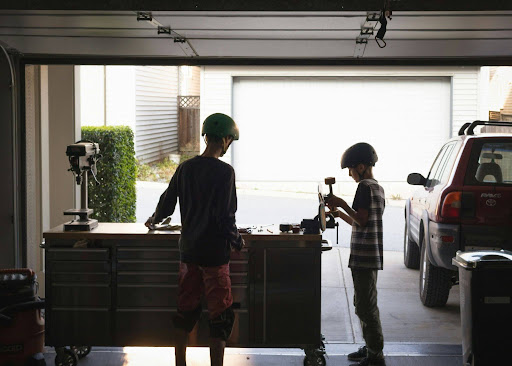
Homeowners in Southwest Florida usually arrive at this search from one of two directions. Some want to use the garage as a workshop, a gym, or a shaded place to sit without cooking in the afternoon heat. Others have worked out that the garage door is the largest opening in the house and want to know what happens to it when a storm arrives. The right product depends on which of those you are solving for, and the fastest way to waste money is to buy one while believing you bought the other.
The Two Products Behind One Search Term
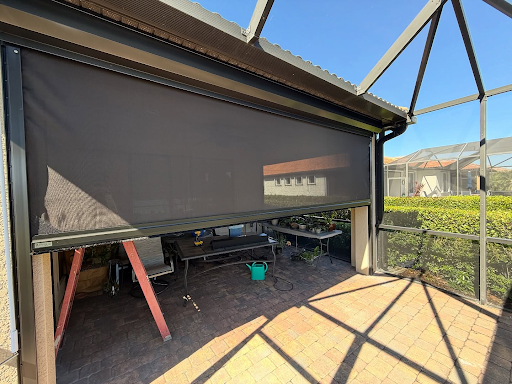
Solar and insect screens. These are retractable mesh systems that mount above the opening and roll down on light guides or side tracks. The mesh cuts glare and heat, keeps insects out, and still lets air move through. Most are motorized, some are hand operated, and all are built to be raised and lowered constantly. What they are not built to do is resist wind load. The fabric and the retention hardware are engineered for comfort.
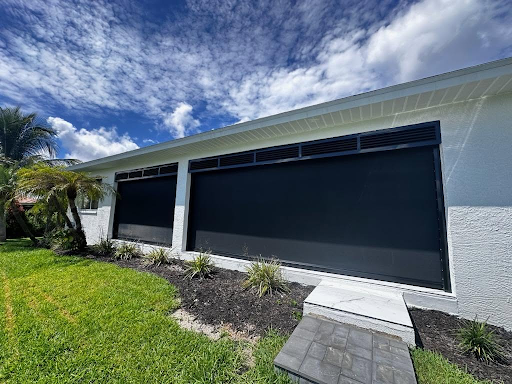
Impact-rated storm screens. These use engineered fabric rather than ordinary mesh. Common options include screens woven with aramid fibers, sold under names such as Kevlar, and reinforced polyester systems. The fabric is held under tension by a retention design that grips it on all sides so it cannot pull free or balloon out of its track under pressure. These systems carry a testing approval, and that approval is specific: it covers a particular product, at a particular maximum size, installed a particular way.
The overlap is what confuses. Both roll down out of a housing. Both preserve airflow and outward visibility in a way a solid shutter does not. Both get described as a retractable screen. Only one of them has engineering behind that description.
Quick Comparison
| Solar and Insect Screen | Impact-Rated Storm Screen | |
|---|---|---|
| Primary purpose | Shade, insect control, airflow | Holding the opening against wind and windborne debris |
| Fabric | Standard or solar mesh | Aramid or reinforced polyester engineered for impact |
| Retention | Light guides or simple side tracks | Tensioned system gripping the fabric on all sides |
| Storm approval | None | Product-specific approval tied to size and installation method |
| Everyday use | Raised and lowered year-round | Deployed ahead of a storm, often used for shade as well |
| If you confuse them | You believe the opening is protected when it is not | You paid for protection you may mostly use for comfort |
Why the Garage Opening Matters More Than It Looks
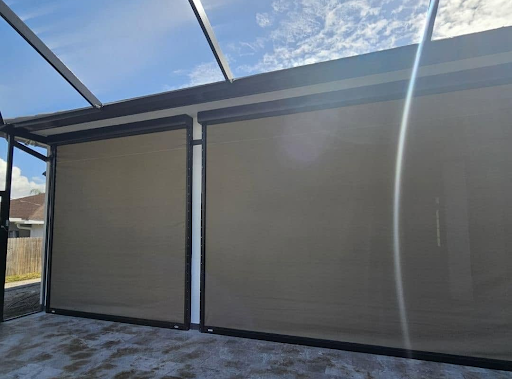
A garage door is usually the widest, tallest, and least rigid opening on a house. That combination makes it the one most likely to give way.
The consequence is not limited to the garage. When a large opening fails during a storm, wind enters the structure and pressurizes the interior. That internal pressure pushes outward on the walls and upward on the roof at the same moment the wind outside is pulling on them. Damage that begins at the garage door often does not end there. It is why building codes treat a garage door as an opening to be protected rather than as a wall, and why wind mitigation inspections pay attention to it.
None of which means every home needs a screen over the garage. Plenty of newer houses already have a rated door that handles the job on its own. It does mean the opening deserves a straight answer rather than an assumption.
Five Questions That Reveal Which Product You Are Being Quoted
Is this product approved for an opening this size? Approvals are size-specific. A screen rated for a six-foot window is not automatically rated for a sixteen-foot garage. Ask for the approval and the maximum span it covers.
How is the screen retained? This difference matters the most. Ask whether the system holds the fabric under tension on all sides or simply runs it down a pair of guides. A screen that can pull out of its track is not protecting anything.
Does it replace the garage door or work alongside it? Some systems mount inside the opening behind the door, others outside it. The answer changes your clearances, your permitting, and whether the garage stays usable with the screen down.
What happens in a power outage? A motorized system should have a manual override. Storms take power out, frequently before the worst of the weather arrives. Confirm you can deploy it by hand.
Who pulls the permit? Storm protection fixed to an opening is permitted work with an inspection at the end. If a quote makes no mention of either, ask why before you sign it.
What It Is Like to Live With One
Homeowners who put a screen over the garage tend to report the same set of changes. The space becomes usable during the day because the mesh takes the edge off direct sun.
Airflow improves noticeably against a closed door. Insects stay outside, which matters most when you are working with the door up in the evening. In daylight, the screen reads one way, so you can see out while anyone outside sees mostly screen.
The tradeoffs are real as well. You lose some clarity of view compared with an open door. A motorized system adds a component that will eventually need service. And a deployed screen does not secure the opening against entry the way a closed door does, so it is not a substitute for shutting the garage when you leave.
Where a Garage Screen Fits in the Larger Plan
A garage screen is rarely the first purchase. Most homes cover windows and doors first, then the lanai or patio, then the garage. The openings that let water and debris straight into living space usually take priority.
If you are working through the whole house, it is worth looking at the same screen technology across several openings. Roll-down screens are used on windows, lanais, patios, and wide openings, and running one system across several of them is generally simpler to operate and to maintain than a mix of unrelated products.
Verdict
A retractable screen over the garage door is a real product and a genuinely useful one. The question was never whether you want one. It is which of the two you are actually buying.
If you want shade, airflow, and fewer insects, a solar and insect screen does that job well and costs less. If you want the opening to hold when a storm comes through, you need an impact-rated system with a documented approval that covers your span. Plenty of homeowners want both, and in that case the impact-rated system generally handles the comfort side too.
The way to settle it is to have the opening measured and to get a direct answer on what will fit and what it is rated to do. Our team handles measurement, design, permitting, and installation as one process, so rather than after it arrives, the approval question is answered before anything is ordered.